


Web Cache Deception: Exploiting Architectural Mismatches
This content is for educational purposes only.
This article is based on PortSwigger research.
What is Web Cache Deception?
Web Cache Deception (WCD) is a vulnerability that occurs when an attacker tricks a caching system into storing sensitive, dynamic content as if it were a public, static resource.
It is not a traditional code flaw like SQLi or XSS. Instead, it results from a parsing mismatch between the caching layer and the origin server. The vulnerability lives in the "gray area" of how two different systems interpret the same URL.
The Architecture of a Cache

The Request Flow:
A cache (CDN or reverse proxy) sits between the client and the origin server to reduce load.
- Request: The user requests a resource.
- Rule Check: The cache checks its configuration to see if the URL looks "cacheable" (e.g., ends in
.css). - Storage: If it’s a "miss," the cache fetches it from the origin and saves a copy.
- Delivery: Future users requesting that exact URL receive the cached version instantly.
The Gap: WCD exploits the discrepancy between:
- What the cache believes it is storing (static content).
- What the origin actually generates (dynamic, sensitive content).
Attack Methodology
The attack is conceptually simple. Imagine you are logged into your bank. Your profile contains your balance and transaction history.
To boost speed, the bank caches files ending in: .css, .js, .png, .jpg.
An attacker crafts a URL like this: https://bank.com/account/profile/nonexistent.css
- The Cache sees
.cssat the end. It thinks: "This is a stylesheet. If the server returns a 200 OK, I'll cache it for everyone." - The Origin Server receives the request. Due to flexible routing, it ignores the
/nonexistent.csssuffix and serves your private profile page. - The Result: The cache stores your private HTML under the name
nonexistent.css. The attacker now simply visits that URL and views your data.
Exploitation Techniques

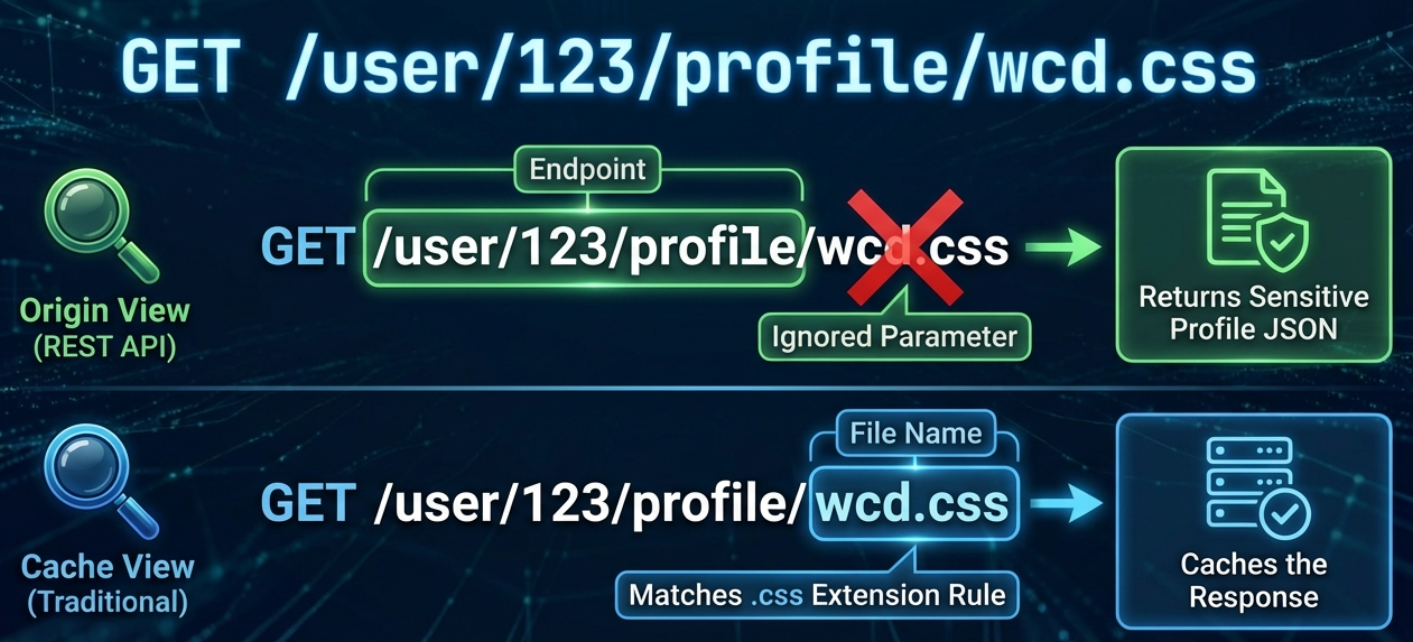
1. Path Mapping Discrepancies
The risk appears when the cache uses file-extension rules while the application uses flexible routing.
- Traditional Mapping:
https://example.com/assets/logo.pngmaps directly to a physical file. - REST-Style Mapping:
https://example.com/users/123/profilemaps to an API logic.
If an attacker appends a fake extension (/profile/test.js), and the server still serves the profile because it "ignores" the trailing path, the cache is successfully deceived.
2. Delimiter Discrepancies
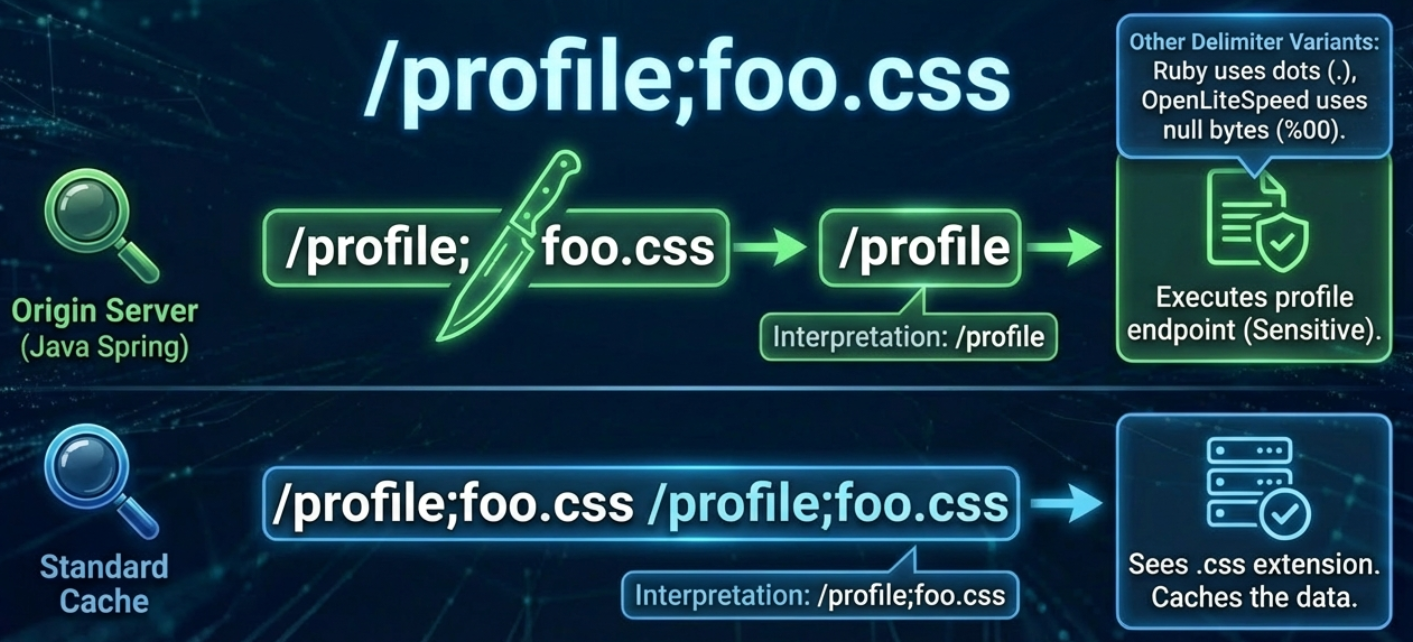
A delimiter (like ?, #, or ;) tells a server where the URL path ends. WCD occurs when the cache and the origin server disagree on which character is a delimiter.
- The Cache's Perspective: It may only recognize
?. It sees/profile;index.cssas a single file path ending in.css. Result: Cacheable. - The Origin's Perspective: It might use a framework (like Spring) that treats
;as a delimiter. It sees/profileand ignores the rest. Result: Sensitive Data.
Common Delimiters to Test:
- Semicolons (
;) - Dots (
.) - Null Bytes (
%00) - Newlines (
%0a)
3. Normalization
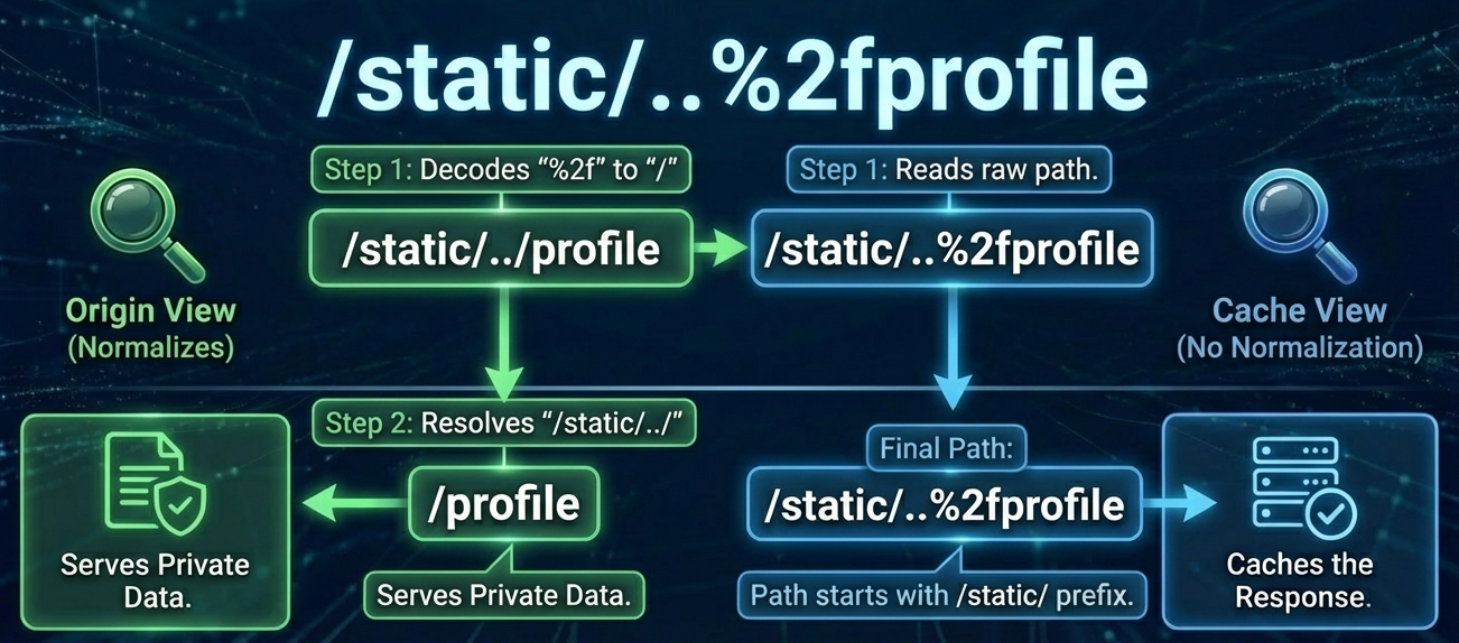
Normalization is how a server "cleans up" a URL (e.g., resolving /../). If the cache and origin normalize the URL in a different order, the attacker wins.
Path Traversal Example: /profile/..%2fassets/style.css
- The Cache: Does not decode the
%2f(/). It sees a URL ending instyle.cssand caches it. - The Origin: Decodes the
%2fand normalizes the path. It resolves/profile/../assets/style.cssback to/profile. - The Deception: The cache saves the private HTML of
/profileunder the key of the "static" CSS path.
Testing & Detection
Testing Tools
- Burp Suite: Use the "Web Cache Deception Scanner" extension.
- Manual Testing: Manually append suffixes like
.cssor.jsto sensitive endpoints. - Header Analysis: Look for these indicators:
X-Cache: HITCache-Control: publicAge: [seconds]
Prevention Strategies
- Strict Cache Rules: Only cache files from specific, authorized folders such as
/static/. - Header Control: Force
Cache-Control: no-store, privateon all sensitive pages to prevent data storage. - Disable Path Info: Configure origin servers to reject any incoming requests that contain extra path information.
- Consistency: Ensure both the cache and origin layers use identical URL normalization logic to avoid discrepancies.
Summary
Web Cache Deception is powerful because it exploits trust. The cache trusts the extension, and the origin trusts the cache. By breaking that trust, attackers turn a performance tool into a data leak.
Comments
Join the discussion! Sign in with GitHub to leave a comment.